

“Doctor, I have never smoked, never chewed gutkha and never used tobacco. Then how did I get oral cancer?”
This is one of the most difficult questions patients ask me.
For years, we have rightly spoken about the strong relationship between tobacco and oral cancer. But somewhere along the way, this has created another belief:
“If I don’t use tobacco, I cannot get oral cancer.”
Unfortunately, that is not true.
Tobacco remains one of the most important preventable risk factors for oral cancer. But oral cancer can occur in people who have never used tobacco.
As an Oral Cancer Surgeon Pune, I occasionally meet patients who are genuinely shocked by their diagnosis because they have lived without tobacco, gutkha or smoking.
Their stories teach us an important lesson:
A healthy habit lowers your risk. It does not make you immune to disease.
A Conversation from My Clinic
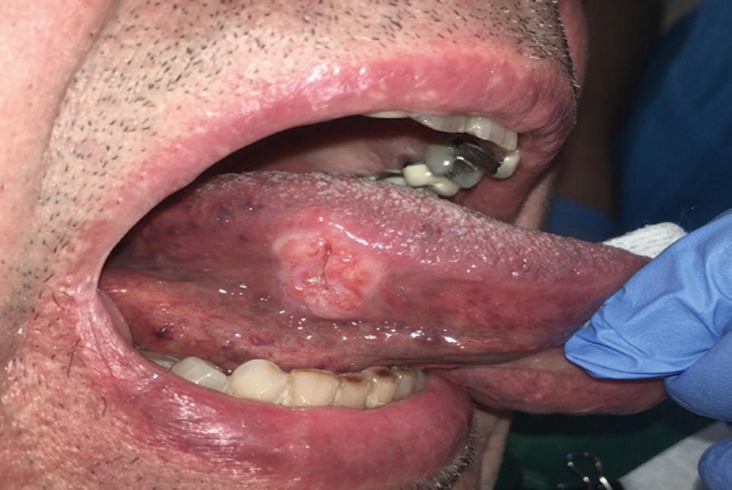
A woman in her fifties once came to my clinic with a persistent ulcer along the side of her tongue.
She had never smoked.
Never chewed tobacco.
Never consumed gutkha or pan masala.
She had initially assumed the ulcer was related to a tooth rubbing against her tongue. Since she had no tobacco habit, cancer wasn’t even on her list of concerns.
When the ulcer continued to persist, she finally sought an opinion.
During our conversation, she asked me:
“Doctor, oral cancer happens because of tobacco. I have never touched tobacco. How can this happen to me?”
Her question wasn’t simply medical.
There was disbelief behind it.
After examination and appropriate investigations, unfortunately, the lesion was confirmed to be oral cancer.
I explained something that I now tell many patients:
“Tobacco increases the risk of oral cancer enormously. But tobacco is a risk factor—not an entry ticket that every oral cancer patient must have.”
For an Oral Cancer Surgeon Pune, recognizing oral cancer in people without traditional habits is particularly important because these patients may delay seeking help precisely because they believe they are not at risk.
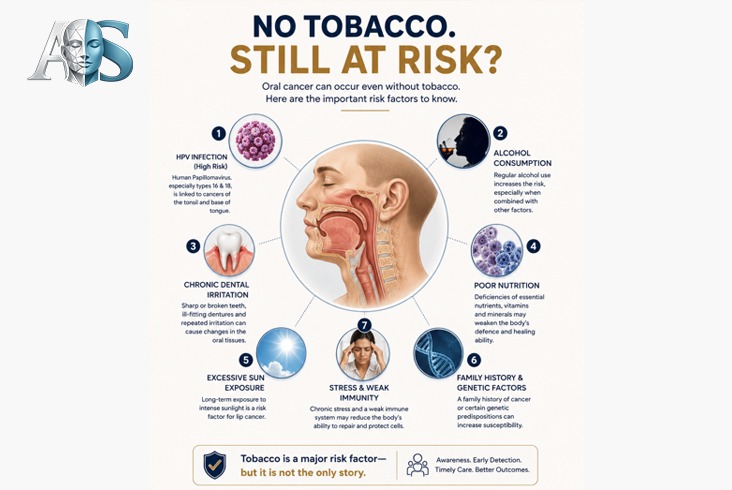
So, What Else Can Increase the Risk of Oral Cancer?
Cancer rarely has one simple explanation.
It develops when cells accumulate changes that allow them to grow abnormally. Tobacco and alcohol can contribute significantly to this process, but they are not the only factors involved.
Age, genetics, immune function, certain infections, environmental exposures and other biological factors may also influence cancer risk.
And sometimes, despite investigating carefully, we simply cannot identify one clear cause.
That uncertainty can be frustrating for patients.
But from a treatment perspective, identifying why cancer occurred is usually less urgent than diagnosing it early and treating it appropriately.
What About a Sharp Tooth or Chronic Dental Irritation?
This deserves special attention because I frequently hear:
“Doctor, this tooth has been rubbing against my tongue for years. Did that cause my cancer?”
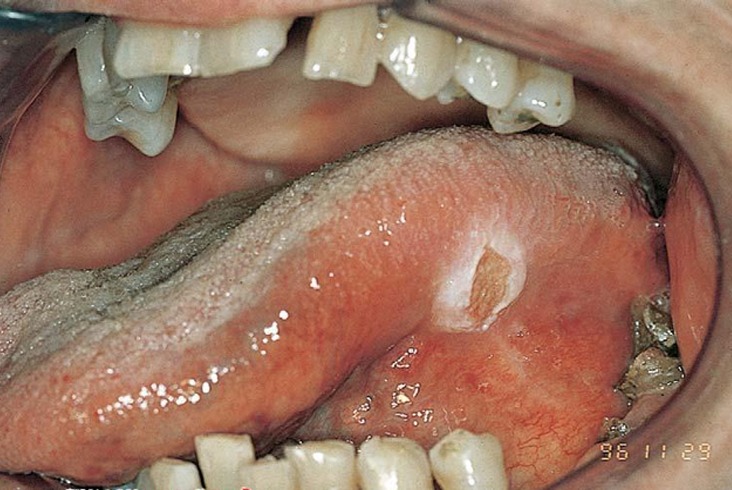
A broken tooth, sharp cusp, poorly fitting denture or rough restoration can repeatedly traumatize the lining of the mouth and certainly cause ulcers or chronic irritation.
However, we should be careful about saying that a sharp tooth directly causes oral cancer. The scientific relationship between chronic mechanical irritation and oral cancer is not as firmly established as it is for tobacco or alcohol.
Nevertheless, persistent trauma should never be ignored.
If a sharp tooth is repeatedly injuring your cheek or tongue, get the dental problem corrected.
More importantly, if the ulcer doesn’t heal after the source of irritation has been removed, it needs further evaluation.
An experienced Mouth Cancer Surgeon or Oral Cancer Specialist Pune may recommend additional investigation or biopsy when appropriate.
Does HPV Cause Oral Cancer?
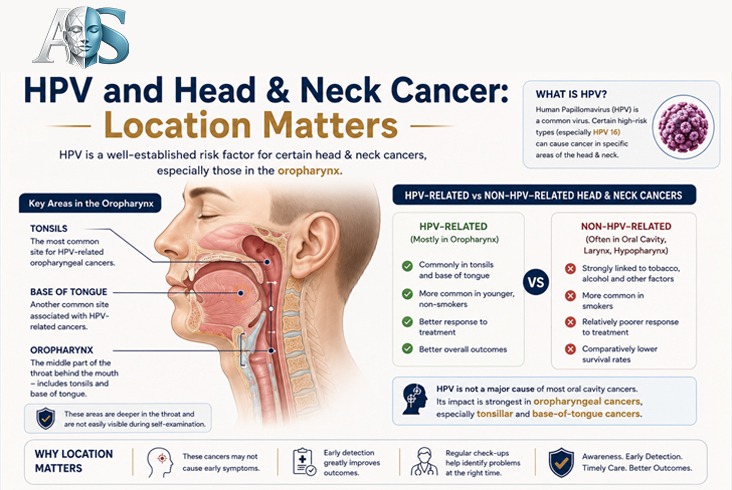
Certain types of Human Papillomavirus (HPV) are strongly associated with cancers of the oropharynx, particularly cancers involving areas such as the tonsils and base of the tongue.
This is slightly different from the typical oral cavity cancers involving the cheek, gums, front portion of the tongue, floor of the mouth or jaw.
Patients often use the terms “mouth cancer” and “throat cancer” interchangeably, but medically they are not always the same disease.
A Head & Neck Cancer Surgeon Pune can help determine exactly where a tumour originates and what factors may be relevant.
Can Oral Cancer Be Genetic?
Patients frequently ask this when nobody in the family uses tobacco.
Most oral cancers are not inherited in a simple way where having an affected parent means the child will develop the same disease.
However, our genes influence how cells respond to damage, repair DNA and control abnormal growth.
Family history may therefore be one piece of a much larger puzzle, but for most patients there is no straightforward hereditary explanation.
So if nobody in your family has had oral cancer, you should still pay attention to persistent changes inside your mouth.
What Symptoms Should a Non-Tobacco User Watch For?
Exactly the same symptoms as a tobacco user.
- A mouth ulcer lasting more than two weeks
- A persistent white or red patch
- Unexplained bleeding
- A lump or thickening inside the mouth
- Persistent tongue discomfort
- Difficulty chewing or swallowing
- Reduced mouth opening
- Unexplained loosening of teeth
- A persistent lump in the neck
None of these automatically means cancer.
But the absence of tobacco use should never be used as a reason to ignore them.
If a suspicious change persists, consultation with an Oral Cancer Surgeon Pune or experienced Mouth Cancer Surgeon is appropriate.
“I Don’t Use Tobacco. So My Risk Must Be Very Low?”
Compared with a long-term tobacco user, avoiding tobacco is certainly an enormous advantage.
Please don’t misunderstand the message of this article.
Not using tobacco is one of the best things you can do to reduce your risk of oral and head & neck cancers.
The message is simply:
Lower risk does not mean zero risk.
This distinction matters because non-tobacco users sometimes wait much longer before seeking medical advice.
They try antibiotics.
Then mouth gels.
Then vitamins.
Then dental treatment.
Months can pass.
As an Oral Cancer Specialist Pune, I would much rather examine someone early and tell them, “This is not cancer,” than meet them months later because everyone assumed cancer was impossible without tobacco.
If Cancer Occurs Without Tobacco, Is the Treatment Different?
Treatment is determined primarily by factors such as the site, stage, tumour characteristics and overall health of the patient, rather than simply whether the person used tobacco.
Early cancers may require relatively limited surgery.
More advanced disease can require removal of involved tissues, treatment of lymph nodes in the neck, and sometimes radiotherapy or chemotherapy.
When surgery affects the jaw, tongue or facial tissues, reconstruction may also become important.
As a Maxillofacial Surgeon Pune, I strongly believe treatment planning should consider not only removal of disease but also what happens afterwards—speech, swallowing, facial appearance and eventually dental rehabilitation.
That philosophy becomes increasingly important as cancer treatment becomes more comprehensive.
What I Want My Patients to Remember
If you don’t use tobacco, continue staying away from it. You’ve already eliminated one of the most important preventable risks.
But don’t let that healthy choice create false reassurance.
Your mouth still deserves attention.
Look at it occasionally.
Attend regular dental examinations.
And if something changes and refuses to return to normal, find out why.
Whether you use tobacco or have never touched it, an ulcer lasting more than two weeks deserves evaluation by an Oral Cancer Surgeon Pune, Head & Neck Cancer Surgeon Pune, or other appropriately trained specialist.
A Note from Dr. Ankit Shah
As an Oral Cancer Surgeon Pune, one sentence concerns me whenever I hear it:
“Doctor, I didn’t think it could be cancer because I have no habits.”
I understand why people think this way. For decades, tobacco and oral cancer have been spoken about together—and for very good reason.
But awareness must now go one step further.
Being tobacco-free dramatically reduces your risk, but it doesn’t give us permission to ignore a persistent ulcer, patch or swelling.
As a Mouth Cancer Surgeon and Maxillofacial Surgeon Pune, I would rather see you early, examine you, and reassure you than have you postpone an evaluation because you considered yourself “too healthy” to develop oral cancer.
So remember one simple sentence:
No tobacco means lower risk—not zero risk.
And regardless of your habits, a change inside your mouth that refuses to heal deserves attention.