

“A white patch does not automatically mean cancer. But a white patch that refuses to disappear deserves an explanation.”
“Doctor, I have had this white patch inside my mouth for months. It doesn’t hurt. Should I be worried?”
This is a question I hear quite often in my clinic.
Sometimes the patch was noticed by the patient while brushing. Sometimes a dentist pointed it out during a routine check-up. And quite often, it has been there for several months because there was no pain, bleeding, or difficulty eating.
That is precisely where the confusion begins.
We tend to associate serious disease with pain. But changes inside the mouth, including some early oral cancer symptoms, can be completely painless.
As an Oral Cancer Surgeon Pune, my advice is simple: don’t panic when you see a white patch, but don’t ignore one that persists either.
Most importantly, find out why it is there.
A Conversation from My Clinic
A gentleman in his early forties once came to my clinic with a white patch on the inside of his cheek.
He wasn’t particularly worried.
In fact, his first sentence was:
“Doctor, there’s no pain. My dentist just told me to get it checked once.”
When I asked how long it had been there, he thought for a moment.
“Maybe six or seven months.”
He had been chewing tobacco for several years. Since the patch wasn’t troubling him, he assumed it was simply a stain caused by tobacco.
But stains usually don’t behave like persistent patches.
On examination, the area needed further evaluation, and I advised a biopsy.
Fortunately, it had not developed into oral cancer. However, the tissue showed changes that meant it could not simply be forgotten. He needed to stop tobacco completely and remain under regular follow-up.
Before leaving, he asked:
“Doctor, if it isn’t cancer, why do I need to keep checking it?”
That question is important.
My answer was:
“Because sometimes our opportunity is not to treat cancer early. It is to identify the changes before cancer ever develops.”
As an Oral Cancer Surgeon Pune, that is one of the most valuable conversations I can have with a patient.
What Exactly Is a White Patch in the Mouth?
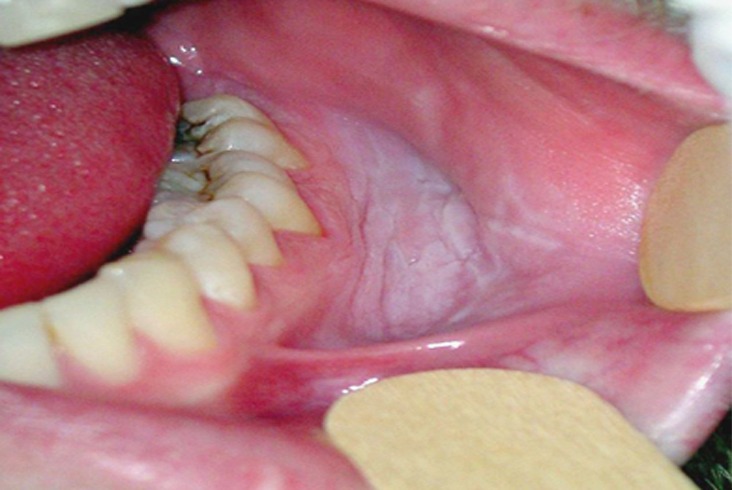
Not every white area inside the mouth is leukoplakia, and not every white patch is dangerous.
White patches can develop for several reasons. Repeated friction from a tooth, certain infections, inflammatory conditions, tobacco exposure, or other changes in the lining of the mouth can sometimes produce a whitish appearance.
Some disappear when the underlying cause is treated.
Others persist.
Leukoplakia is a clinical term used for certain persistent white patches after other causes have been considered. Some leukoplakias may contain abnormal cellular changes called dysplasia, which can increase the risk of future cancer development.
This is why an experienced Mouth Cancer Surgeon does not judge a white patch simply by its colour.
Its location, texture, duration, associated habits, clinical appearance and changes over time all matter.
“But Doctor, It Doesn’t Hurt.”
This is probably the sentence I hear most often.
And it deserves repeating:
Pain is not a reliable way of deciding whether a mouth lesion is harmless.
Some concerning white or red patches cause absolutely no discomfort.
You may eat normally.
You may speak normally.
You may have no swelling.
Yet the patch may continue changing quietly.
That doesn’t mean every painless patch is dangerous. It simply means absence of pain should not be your reason for ignoring it.
An Oral Cancer Specialist Pune can often distinguish obviously harmless conditions from lesions that require observation, treatment, or biopsy.
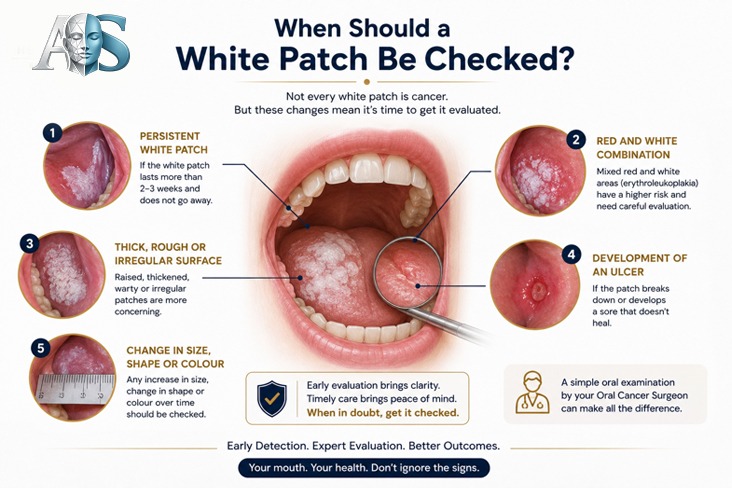
Which White Patches Should Make You More Alert?
Please arrange an examination if you notice a white patch that does not go away, particularly when it:
- Persists for several weeks
- Becomes thicker or rougher
- Develops red areas within it
- Starts ulcerating or bleeding
- Gradually increases in size
- Is associated with reduced mouth opening
- Occurs in someone using tobacco, gutkha, pan masala, or areca nut
- Is accompanied by a non-healing ulcer or neck swelling
These findings do not automatically mean oral cancer.
But they are good reasons to consult an experienced Mouth Cancer Surgeon or Head & Neck Cancer Surgeon Pune rather than repeatedly trying gels or home remedies.
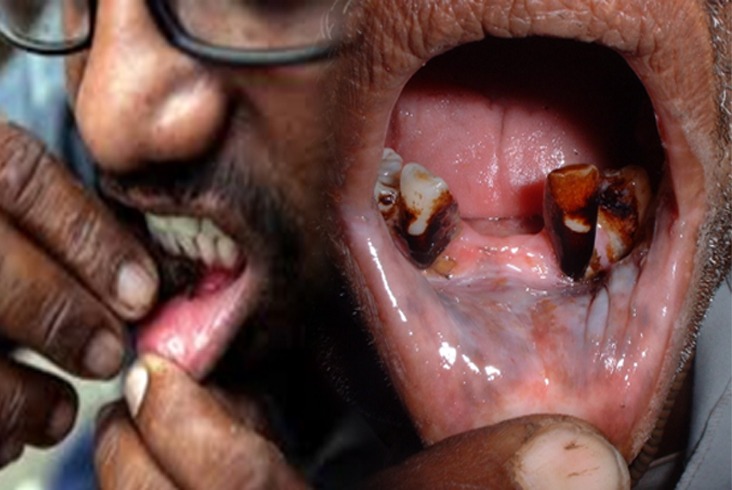
What Does Tobacco Have to Do With White Patches?
A great deal.
The lining of your mouth is repeatedly exposed to tobacco when you chew gutkha, khaini, paan with tobacco, mishri, or similar products.
Many people even keep tobacco in exactly the same location inside their cheek for years.
That repeated exposure can produce chronic changes in the tissue.
A tobacco white patch should therefore never simply be dismissed as “something caused by tobacco.”
That may actually be the reason it deserves attention.
As an Oral Cancer Surgeon Pune, I would much rather examine ten tobacco users whose patches turn out to be harmless than see one patient after a suspicious patch has been ignored for a year.
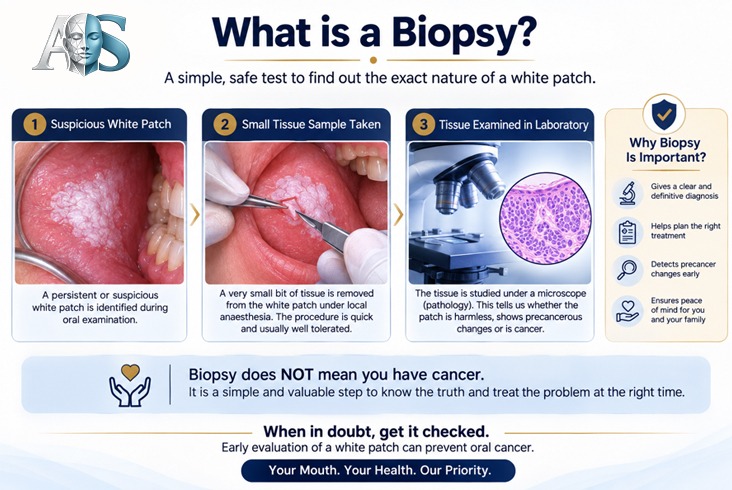
Does Every White Patch Need a Biopsy?
No.
And this is where clinical judgment becomes important.
Some lesions can be identified clinically and treated by removing the underlying cause. Others can initially be monitored.
But if the patch looks suspicious, persists despite eliminating possible causes, changes in appearance, or has other concerning features, your doctor may recommend a biopsy.
A biopsy does not mean your doctor believes you definitely have cancer.
It simply allows a small tissue sample to be examined under a microscope so that we understand what is actually happening at the cellular level.
For a Maxillofacial Surgeon Pune, deciding where and when to biopsy is as important as performing the procedure itself.
What Happens If Precancerous Changes Are Found?
First, don’t assume the worst.
Precancerous does not mean cancer.
Depending on the type and severity of changes, management may include eliminating tobacco or other irritants, treating contributing conditions, removing selected lesions, or keeping the area under regular surveillance.
This is where follow-up becomes extremely important.
Your Oral Cancer Surgeon Pune or Maxillofacial Surgeon Pune may recommend periodic examinations so that any future change can be detected early.
And if oral cancer is ever identified, earlier diagnosis generally gives us better treatment options and a greater opportunity to preserve speech, swallowing, appearance, and quality of life.
What I Want My Patients to Remember
Don’t become frightened every time you notice something white inside your mouth.
But don’t become comfortable with a patch simply because it has been there for months without hurting.
Persistence is information.
If something inside your mouth isn’t returning to normal, your body is giving you a reason to investigate.
A timely examination by an Oral Cancer Specialist Pune or Head & Neck Cancer Surgeon Pune may simply reassure you that everything is fine.
And occasionally, that same examination can identify a problem at exactly the stage when we have the best opportunity to act.
A Note from Dr. Ankit Shah
As an Oral Cancer Surgeon Pune, some of the consultations that give me the greatest satisfaction end without an operation.
A patient comes worried about a white patch.
We examine it.
We investigate when necessary.
We identify the cause early, help the patient stop tobacco, and continue monitoring.
Months later, they return healthy.
Those consultations remind me that being a Mouth Cancer Surgeon isn’t only about treating established cancer. It is also about recognizing the warning signs that may allow us to prevent a much bigger problem.
So if you have noticed a persistent white patch inside your mouth, don’t spend months wondering whether it is dangerous.
Get it examined. Understand what it is. And then act appropriately.
Because sometimes the best oral cancer treatment is the surgery we never have to perform.