
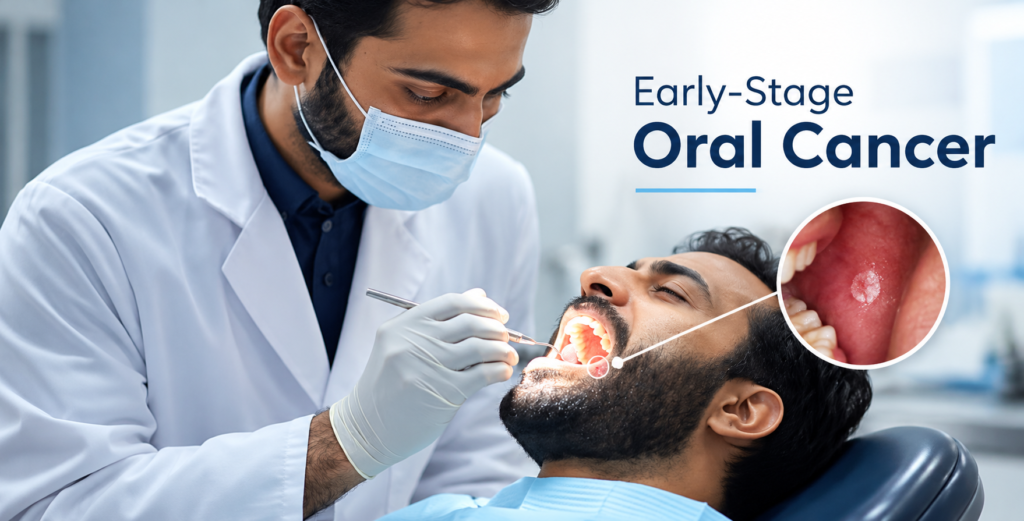
Sometimes, the difference between a small operation and a major reconstruction is not how aggressively we treat cancer, but how early we discover it.
When patients hear the words oral cancer, they often imagine a major operation. Removal of part of the jaw. A long hospital stay. Facial changes. Difficulty eating or speaking.These fears are understandable. I regularly encounter them while discussing treatment. But something important often gets overlooked.
Not every oral cancer requires extensive surgery.
Some cancers, when identified early, can be treated with relatively limited procedures while preserving much of the surrounding healthy tissue.And that is one of the strongest reasons I encourage patients not to ignore persistent changes inside their mouths.
What I Look for When Planning Oral Cancer Surgery
When I examine a patient diagnosed with oral cancer, my first question is not simply, “How large is the tumour?”I want to understand several things.How deeply has it grown? Which structures are involved? Is the jaw affected? What is the condition of the lymph nodes in the neck? How much tissue must be removed to achieve adequate cancer clearance?
These questions guide the operation.For example, a small cancer limited to the lining and superficial tissues of the tongue may require a relatively limited excision.But a tumour that has grown deeply into the tongue can require a more extensive operation, even if its surface appearance seems modest.
The visible size of a cancer does not always tell us its complete story.
This is why examination, biopsy and appropriate imaging are essential before deciding treatment.
Early Cancer Can Mean More Tissue Preservation
One of the most important principles of cancer surgery is achieving adequate tumour clearance. We cannot compromise this objective merely to make an operation smaller. However, when cancer is detected before it has extensively involved surrounding structures, we may have more opportunities to preserve healthy tissue.
Consider a tumour involving the cheek.If identified early, it may be possible to remove the affected area without sacrificing large amounts of adjacent tissue. If the same tumour progresses and involves deeper structures, surgery may become considerably more complex.The difference is not simply the duration of the operation.It may affect chewing, mouth opening, appearance and rehabilitation.Preserving normal tissue whenever oncologically safe is an important part of good surgery.
Does Early Oral Cancer Always Mean a Small Operation?
Not necessarily.This is a distinction I want patients to understand.Early-stage oral cancer generally offers better treatment opportunities, but the exact operation depends on the tumour’s location, depth, pathological features and other findings.Some relatively small tumours still require treatment of lymph nodes in the neck because of the risk of microscopic spread.Others may require reconstruction because of their location, even when the tumour itself is not large.
So, when someone asks me, “Doctor, it is early cancer. Can you do a very small operation?” my answer is:
“We will preserve everything we safely can, but we will not compromise cancer treatment to make the surgery smaller.”
That balance is central to responsible surgical decision-making.
Why Does the Location of Cancer Matter?
Imagine two cancers of similar size.One is situated in an area where removal causes relatively little functional disturbance.The other involves a critical part of the tongue.Although their measurements may be similar, their surgical implications can be very different.The tongue is essential for speech, swallowing and moving food inside the mouth.Similarly, cancers close to the jaw, floor of the mouth or important facial structures require careful planning.
As a surgeon involved in oral cancer treatment and maxillofacial reconstruction in Pune, I consider both cancer clearance and the function of the structures we hope to preserve.
The best operation is not necessarily the smallest operation. It is the most appropriate operation for that patient.
What About Jaw Removal and Reconstruction?
This is one of the most frightening possibilities for patients.
“Doctor, will you have to remove my jaw?”
I believe this question deserves a careful explanation rather than an immediate yes or no.
If cancer has not involved the jaw, preserving it may be possible.
When bone involvement is present, the extent and pattern of disease help determine whether a limited bone removal or a more extensive resection is necessary.
In selected cases, advanced reconstruction using bone from another part of the body may be required.But the opportunity to avoid extensive reconstruction, when safely possible, is another reason early diagnosis matters.For me, reconstruction is not merely about repairing what has been removed.
It is about anticipating the patient’s future ability to eat, speak, maintain facial appearance and potentially undergo dental rehabilitation.
The Real Cost of Delaying an Examination
Many patients postpone consultation because an ulcer does not hurt.Others assume a white patch is caused by tobacco or that a small swelling will disappear.Sometimes these changes are harmless.But when a suspicious lesion persists, waiting without evaluation can allow a treatable problem to progress.
A persistent ulcer, unexplained growth or red or white patch deserves examination, particularly if it has remained for more than two weeks.
This does not mean every such lesion is cancer.
It means we should establish the cause rather than repeatedly guessing.
Early detection is valuable not only because it can improve the chances of successful treatment, but because it may also reduce the functional consequences of treatment.
Three Questions Worth Asking After an Early Diagnosis
If you have been diagnosed with early-stage oral cancer, I encourage you to ask your treating surgeon:
1. How far has the cancer actually extended?
2. Which normal structures can be safely preserved?
3. Will I need neck treatment, reconstruction or rehabilitation?
These questions help you understand the operation beyond the simple label of “early cancer.”
How I Think About Early Oral Cancer
When I plan surgery, I am always thinking about two responsibilities.The first is removing the cancer adequately.The second is preserving as much of the patient’s future quality of life as safely possible.Sometimes this means a relatively limited operation.Sometimes it requires more extensive surgery and reconstruction.But the principle remains unchanged.
Cancer clearance must never be compromised. Unnecessary loss of function should never be accepted casually.
That is why I believe the greatest advantage of early diagnosis is not simply finding cancer when it is small.It is giving patients and their surgical teams more opportunities to make thoughtful treatment decisions.Because in oral cancer surgery, what we preserve can matter almost as much as what we remove.
Dr. Ankit Shah
Oral Cancer, Head & Neck Surgery and Maxillofacial Reconstruction | Pune